Hair transplant surgery delivers dramatic results, including a restored hairline, renewed density, and the confidence that comes with looking like yourself again. However, many patients don’t realize that the surgery itself represents only part of a comprehensive hair restoration strategy.
Medical management (the prescription medications that strengthen existing hair and prevent future loss) help determine the longevity of your transplant results.
“The bigger picture is that the hair transplant is the architectural work, and then the medications are the long-term maintenance plan and structural foundation,” explains Stacie, NP, Hair Team Manager and certified trichologist at the Quatela Center for Hair Restoration.
Understanding why medical therapy matters before and after your procedure is essential to maximizing your investment and achieving sustainable results.
What Is Medical Management for Hair Loss?
Medical management refers to FDA-approved prescription medications that address the hormonal and biological factors driving pattern hair loss. The two primary medications used in hair restoration are:
Finasteride (Propecia) An oral medication that blocks the conversion of testosterone to dihydrotestosterone (DHT), the hormone responsible for follicle miniaturization in pattern baldness. By reducing DHT levels by approximately 70%, finasteride halts the progressive shrinking of hair follicles that characterizes androgenetic alopecia.
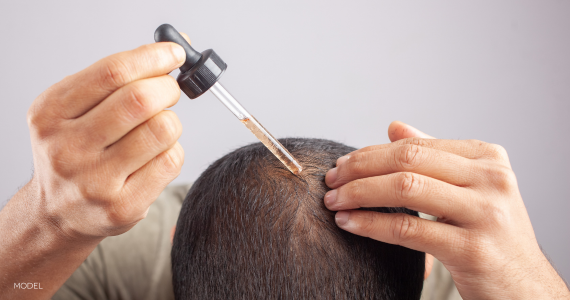
Minoxidil (Rogaine) A topical treatment applied directly to the scalp that increases blood flow to follicles, extends the growth phase of the hair cycle, and enlarges miniaturized follicles so they produce thicker, more visible hair.
These medications work through different mechanisms, which is why they’re often prescribed together for comprehensive management. Finasteride addresses the root hormonal cause while minoxidil optimizes the growth environment.
Why We Recommend Medical Management Before Hair Transplant Surgery
Most patients assume they’ll start medications after their transplant. In reality, beginning medical therapy before surgery provides significant advantages that directly impact your surgical outcomes.
Strengthening Donor Hair Quality
“When you come in to see us for a consult, we most often times recommend starting some medical management or medical therapies before actually coming in for a transplant,” Stacie explains. “This is really important because it helps to strengthen your hair so that when we’re actually taking it from the back of your head, those hairs are really strong.”
Your donor area (typically the back and sides of your scalp where follicles are genetically resistant to balding) provides the grafts we transplant to thinning areas. While these follicles won’t miniaturize like those affected by pattern baldness, their overall health and strength still matter. Healthier donor follicles survive the extraction and transplantation process better, leading to higher graft survival rates and better growth.
Medical management improves donor hair quality by:
- Increasing follicle size and hair shaft thickness
- Enhancing blood supply to follicles
- Optimizing the growth phase duration
- Reducing any inflammation affecting the scalp
Regrowing Miniaturized “Baby Hairs”
One of medical management’s most valuable pre-surgical benefits is reversing early-stage miniaturization (those thin, wispy hairs that signal progressive hair loss).
“A lot of times you have these little wispy hairs, they look like little baby hairs,” Stacie notes. “The medications can help to regrow those as well and it can help so much so that we don’t have to transplant into that area as much as we would without the medications.”
This is crucial for donor supply optimization. Your permanent donor hair is finite. Once it’s harvested and transplanted, that supply is depleted. If medications can reverse miniaturization and restore density in certain areas without surgery, those grafts remain available for potential future procedures.
Reducing the Number of Grafts Needed
By strengthening existing hair and regrowing miniaturized follicles, medical management can significantly reduce the number of grafts required to achieve your desired density. This provides multiple benefits:
Cost Efficiency: Fewer grafts needed means lower surgical costs while still achieving excellent coverage.
Donor Conservation: Preserving donor supply provides flexibility for addressing future hair loss or enhancing density in specific areas.
Better Long-Term Planning: Starting with a smaller, more strategic transplant while medications work throughout your scalp creates a more sustainable long-term approach than attempting to do everything surgically at once.
Optimal Timeline: How Long Before Surgery Should You Start?
“Ideally, the sooner you start on these medications, the better,” Stacie advises. “Usually we like to see people on these medications for three to six months before transplant so we can really see the difference that these are making in your hair.”
Three to six months allows enough time for medications to:
- Complete at least one full hair growth cycle
- Demonstrate visible improvements in hair quality and density
- Stabilize active hair loss
- Optimize your scalp for transplantation
That said, even shorter timeframes provide benefits. “However, even if you’re on them for a month before transplant, that’s going to be super helpful as well,” Stacie notes.
The key is starting as soon as possible once you’ve decided to pursue hair restoration. Every week on medical management improves your surgical foundation.
The Critical Importance of Post-Transplant Medical Management
If pre-surgical medical management optimizes your procedure, post-transplant medication continuation ensures your results last.
Understanding Transplanted vs. Native Hair
Here’s the fundamental reality of hair transplantation that every patient must understand:
“The hairs that we do take from the back of your head and transplant to either the front or the crown, those will always stay there. They will never fall out in theory,” Stacie explains. “However, the hairs that are there, we call them native hairs, those can continue to fall out over time.”
Transplanted hair is permanent. Follicles moved from your donor area carry their genetic resistance to DHT. They’ll continue growing in their new location for your lifetime.
Native hair remains vulnerable. Any existing hair in the recipient area that wasn’t transplanted remains susceptible to the same hormonal factors that caused your original hair loss. Without medical management, these native hairs will continue miniaturizing and eventually be lost.
What Happens Without Medication
Imagine this scenario: You undergo a successful frontal hairline restoration. The transplanted grafts grow beautifully, creating a natural, dense hairline. You look great.
But you stop taking medications prescribed to protect your native hair.
Over the next few years, the native hairs behind your restored hairline—the hairs that provided natural-looking density between transplanted grafts—begin thinning. Your hairline remains intact (transplanted hair is permanent), but the area immediately behind it becomes sparse, creating an unnatural “island” appearance.
This pattern of transplanted hair surviving while surrounding native hair continues thinning causes patients to return for additional procedures to fill in areas that medications may have been able to preserve.
How Medications Preserve Your Investment
“What the medications do is they help to preserve them for as long as possible,” Stacie emphasizes.
Post-transplant medical management:
Protects Native Hair: Medications continue blocking DHT and optimizing follicle health, preventing the progressive miniaturization that would otherwise continue in non-transplanted areas.
Maintains Overall Density: By preserving native hairs interspersed with transplanted follicles, medications maintain the natural density and appearance that makes results look organic rather than obviously transplanted.
Prevents Future Procedures: Many patients who discontinue medications eventually require additional transplants to replace native hair that was lost. Continuing medical management often eliminates or significantly delays the need for revision procedures.
Maximizes Surgical Investment: You’ve invested time, money, and donor supply in your transplant. Medications protect that investment by ensuring the comprehensive results you achieved remain comprehensive long-term.
When to Resume Medications After Surgery
Timing medication resumption after surgery depends on the specific formulation:
“After transplant, patients can restart their medications usually within a week of surgery,” Stacie explains. “If they’re topical, we have you wait a little bit longer, like in the three to four week range post-op.”
Oral medications (finasteride): Typically resumed within one week post-surgery. Since these work systemically rather than being applied to the healing scalp, they can be restarted quickly without interfering with graft healing.
Topical medications (minoxidil): Resumed around three to four weeks post-operatively, once initial healing is complete and scabs have naturally fallen off. This timing ensures the topical solution doesn’t interfere with graft attachment or cause irritation to healing recipient sites.
Your surgeon will provide specific instructions based on your individual healing progress and the exact medications prescribed.
The Complete Picture: Surgery + Medical Management
Understanding the relationship between surgical restoration and medical management helps set realistic expectations and ensures commitment to the complete treatment approach.
Hair Transplant: The Architectural Work
Surgical hair restoration accomplishes what medications cannot:
- Restores hair in completely bald areas where follicles are dead
- Rebuilds your frontal hairline with permanent, DHT-resistant follicles
- Creates density in severely thinned zones beyond what medical therapy alone can achieve
- Delivers immediate (once healed) structural improvement in your appearance
Think of your hair transplant as the design and construction of a building. It creates the visible structure, the aesthetic framework that defines how your restoration looks.
Medical Management: The Maintenance and Foundation
Medical therapy accomplishes what surgery alone cannot:
- Prevents continued loss of native hair throughout your scalp
- Strengthens and maintains existing hair that doesn’t need transplanting
- Optimizes the environment for both transplanted and native hair to thrive
- Provides ongoing protection against the hormonal factors driving your hair loss
“The bigger picture is that the hair transplant is the architectural work, and then the medications are the long-term maintenance plan and structural foundation,” Stacie emphasizes.
Without the foundation (medical management), even the most beautiful architectural work (your transplant) will deteriorate over time as native hair continues to thin around transplanted grafts. The medications provide the underlying support system that keeps your entire restoration stable and comprehensive.
Common Questions About Medical Management
“Do I have to take medications forever?”
Pattern hair loss is a progressive, lifelong condition. Without medical management, the biological factors that caused your original hair loss continue operating. Most patients continue medications indefinitely to maintain results, though some may reduce dosing or frequency over time under medical supervision.
“What if I stop medications after my transplant?”
Transplanted hair will remain—it’s genetically resistant to DHT. However, native hair in non-transplanted areas will likely continue thinning, potentially creating an unnatural appearance and necessitating additional procedures to maintain comprehensive coverage.
“Can I just do medications without surgery?”
For patients with early-stage hair loss or mild thinning, medical management alone often provides satisfactory improvement. However, medications cannot regrow hair in completely bald areas where follicles are already dead. These zones require surgical transplantation. Your consultation will determine whether medications alone suffice or if surgery is necessary to achieve your goals.
“Are there side effects?”
Both finasteride and minoxidil have been extensively studied and used for decades. Most patients tolerate them well. Potential side effects are discussed thoroughly during consultation, and we monitor your response to ensure medications work effectively without problems.
“How much do medications cost?”
Medical management is less expensive than surgery. Generic formulations are widely available, and many insurance plans cover these prescriptions. The cost of lifelong medical management represents a fraction of what you’d spend on additional surgical procedures to replace native hair lost without medication protection.
Starting Your Comprehensive Hair Restoration Journey
If you’re considering hair transplant surgery, understanding the role of medical management is essential to achieving optimal, lasting results.
At the Quatela Center for Hair Restoration, we don’t just perform procedures. We design comprehensive treatment strategies that integrate surgical precision with proven medical therapies. Our board-certified facial plastic surgeons and specialized hair team, led by Stacie, work together to create personalized plans that address your complete hair loss picture.
Your consultation will include:
- Thorough evaluation of your hair loss pattern and progression
- Assessment of whether medical management alone might achieve your goals
- Discussion of optimal timing for medications before surgery
- Clear explanation of post-transplant medication protocols
- Honest conversation about long-term maintenance requirements
The goal is restoring your hair and creating results that last.
Ready to explore comprehensive hair restoration? Request your consultation online or call the Quatela Center for Hair Restoration at 585.244.0323.
Leave a Reply