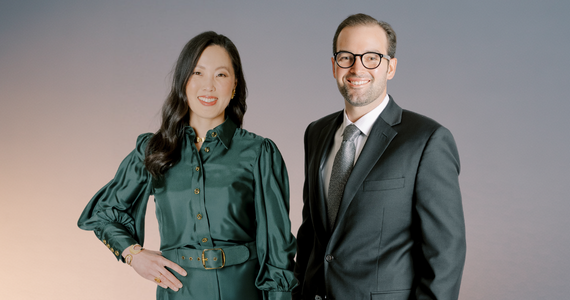
A conversation with Dr. Heather Lee and Dr. Alex Montague
When you consult with a hair restoration specialist, you’re making a decision that will affect not just how you look next month or next year, but how you look and feel for the next 20, 30, or even 40 years of your life.
Yet many patients approach hair restoration as though the goal is to achieve results today, without considering what those same results will look like when they’re 20 years older. This short-term thinking creates problems that become painfully obvious years later.
The difference between adequate hair restoration and exceptional long-term results often comes down to one thing: whether your specialist thinks like a technician performing a procedure or like a steward planning for your future.
The Stewardship Philosophy
“The commitment is not to do a procedure,” explains Dr. Heather Lee. “The commitment is to understand you and your hair loss and take care of you now, but also make sure that you look and feel your best 10, 20, 30 years from now.”
This perspective represents a fundamental shift in how hair restoration is approached. Rather than viewing the transplant as a standalone event, a stewardship mindset treats it as the beginning of a decades-long relationship focused entirely on your long-term well-being.
This means several things in practice:
Conservative Decision-Making It means recommending against certain procedures not because they won’t work today, but because they’ll create problems tomorrow. It means telling a 23-year-old with early-stage hair loss that he’s not yet a candidate for transplant, even though surgery could make him look better immediately. It means resisting the temptation to lower a hairline as far as a patient wants because doing so would deplete donor supply he’ll need later.
Protective Donor Site Management Your permanent hair comes from a limited supply. Once donor follicles are harvested and transplanted, they’re gone. There are no backup sources. A specialist thinking only about today’s results might use donor hair inefficiently, creating a situation where the patient has ample coverage in restored areas but nothing left if future hair loss progresses.
A specialist thinking about 30 years from now carefully preserves donor hair for future procedures, uses it strategically in the most aesthetically important areas first, and ensures every graft serves maximum purpose.
Age-Appropriate Design This is one of the most overlooked aspects of long-term hair restoration success: a hairline that looks perfect on a 35-year-old can look wrong on a 55-year-old or 65-year-old.
“When you’re in your thirties, even forties, you’re really looking for something that looks really youthful, and you would love to have that hairline that you had in your teens and twenties,” Dr. Lee notes. “But truthfully, as you age, if you have an older person that has a hairline like that of a 19-year-old, you’re kind of like, what’s going on? It doesn’t look quite right.”
Hair naturally recedes with age. This is normal and expected. A hairline that defies this natural progression looks unnatural, even if it’s technically impressive. The most sophisticated hair restoration creates results that evolve naturally with aging, looking perfect not just today but 20 years from now.
The Problem with Short-Term Thinking
The consequences of short-term thinking become visible only years later, which is why many patients don’t realize they’ve made problematic decisions until it’s too late to correct them easily.
The Depleted Donor Problem A patient comes in with early-stage hair loss. They want density restored across their entire scalp. A technician-focused approach might accomplish this by using aggressive transplant strategies that look great initially. But 10 years later, as the patient’s natural hair continues thinning in areas that weren’t transplanted, the restored areas look isolated and unnatural. Worse, there’s no donor hair left to fill in the gaps.
A stewardship-focused approach instead tackles the frontal hairline first (the most aesthetically important area), implements medical management to preserve existing hair, and preserves donor supply for future procedures if needed. Results may be more conservative initially, but they remain cohesive and natural-looking as the patient ages.
The Unnatural Hairline Another common mistake: creating a hairline that’s either too low or too uniform for the patient’s age. A hairline positioned mid-forehead might look youthful on a 25-year-old, but it requires exponentially more grafts and creates an unusual appearance as the patient ages.
Dr. Alex Montague explains: “The lower you bring your hairline, the graft number needed just skyrockets. You know, it’s sort of an exponential growth. And as we’ve been saying throughout this entire conversation, we don’t have an infinite number of follicles to use.”
Additionally, overly uniform hairlines (perfectly symmetrical, consistently dense) look surgical because that’s not how natural hair grows. Real hairlines have irregularity, variation, and softness. A specialist thinking 30 years ahead creates hairlines that look naturally imperfect today and will continue looking natural decades from now.
The Artificial Appearance Some patients experience what Dr. Lee calls the “fence post” or “row of corn” phenomenon. When grafts aren’t distributed with proper density and spacing, they create a visible linear pattern. Initially this might be hidden by surrounding hair, but as that native hair thins over time, the artificial pattern becomes increasingly obvious.
A stewardship approach ensures that transplanted grafts are distributed thoughtfully across the entire area, creating natural density and spacing that continues looking good as surrounding hair ages.
Why Early Intervention Matters
One of the most important long-term decisions is how soon you address hair loss. This isn’t about vanity, but about preserving your options.
“I had a patient who I saw very early in my practice,” Dr. Lee recalls. “He came back to see me about seven years later. We talked about medical management. He declined it at that time. And so just to see what seven years had done, oh gosh. It really puts us a little bit behind the eight ball, whereas if we had done even medical management for seven years, I think we would’ve been in a completely different situation.”
This is the reality of hair loss: it’s progressive. It won’t stop on its own. Every year you delay intervention, more follicles become permanently damaged. What could be managed with medical therapy today may require surgical intervention tomorrow. What could be addressed with a moderate transplant today may require multiple surgeries later.
Early intervention doesn’t necessarily mean immediate surgery. It means beginning some form of treatment, whether that is medical management, PRP or PRFM therapy, or other approaches, that slows progression and preserves follicles while you make decisions about your future treatment.
The Age 25 Consideration
One guideline in the industry is to avoid transplant surgery in patients younger than 25. This isn’t because hair transplants don’t work on young patients. It’s because of the stewardship principle.
“When you’re really, really young and you’re first experiencing that temporal loss, it would be easy to take some hairs from back here and pile them in there and make it look thicker,” Dr. Montague explains. “But what you’re not doing is sort of seeing the future. This patient’s 23 now and they’re already progressing, so it’s very likely it’s gonna progress fast and you’re gonna pile a bunch of hair up front and then they’re gonna lose it behind that. And you’ll have then depleted their donor site.”
However, this isn’t an absolute rule. Some patients experience such aggressive hair loss that “the future is here. The future is now.” In these cases, where progression is so rapid that waiting makes no sense, transplant at a younger age may be appropriate.
The key is that the decision accounts for future progression, not just current appearance.
The Long-Term Doctor-Patient Relationship
“That is why he has patients who have been with him for decades, and that is something that I think is so important,” Dr. Lee says of Dr. Quatela’s approach.
Hair restoration isn’t a one-time event. It’s the beginning of an ongoing relationship with a specialist who understands your specific situation, monitors your progression, adjusts treatment as needed, and helps you navigate decisions over years and decades.
These long-term relationships enable several things:
Customized Progression Over time, your specialist learns your hair loss pattern better than you do. They know how fast your hair is thinning, which areas are most affected, and how your body responds to different treatments. This allows them to adjust your protocol continuously for optimal results.
Preventive Planning Rather than reacting to hair loss as it happens, a long-term relationship allows proactive planning. Your specialist can anticipate future needs and make decisions today that position you best for tomorrow.
Evolutionary Approach Your life changes. Your style preferences evolve. Your professional demands shift. A specialist in a long-term relationship adapts recommendations to your changing circumstances rather than following a rigid protocol.
Results That Improve Over Time One patient described noticing that “my hair is better now than it was three years ago,” even years after his transplant. This happens when ongoing medical management, maintenance treatments like PRP, and careful preservation strategies combine to create results that actually improve with time rather than plateau or decline.
Making Decisions That Serve Your Future Self
When you’re considering hair restoration, ask yourself and your specialist these questions:
Will this look natural 20 years from now? Not just next month. Will your hairline still appear appropriate? Will the density look organic as surrounding hair ages?
Does this preserve my options? Does this decision use donor supply efficiently? Does it position you well if your hair loss progresses? Does it leave room for future procedures if needed?
Is this the most strategically important area? Are you tackling what matters most aesthetically? For most men, this is the frontal hairline. For most women, it’s the crown and frontal density. Starting with the most important area ensures you get maximum visual benefit even if you never pursue additional procedures.
Am I committed to ongoing management? Hair restoration isn’t complete after surgery. Long-term success requires ongoing medical management, maintenance treatments, and regular follow-up. Are you willing to make this commitment?
Have I chosen a specialist who thinks long-term? Do they ask about your long-term goals, not just immediate appearance? Do they discuss conservative design principles? Do they seem to care about how you’ll look 20 years from now, not just 20 weeks?
The Future-Focused Approach
“Taking a hair and moving a hair is not that technically difficult,” Dr. Montague notes. “But what is difficult is being a good steward of your donor site and making sure – I think the phrase I use with a lot of my patients in consultation is that – it’s my job to sort of see the future, like 20, 30 years from now, what this is gonna look like. So that what we do now serves you well in the future.”
This is the essence of the stewardship philosophy. Hair restoration, done right, is about building results that will serve you throughout your life. It’s about making conservative, thoughtful decisions today that position you optimally 10, 20, 30 years from now.
The best hair restoration specialists aren’t primarily focused on the procedure itself. They’re focused on being stewards of your appearance and your confidence for decades to come. They think not just about making you look better today, but about ensuring every decision serves your long-term well-being.
This kind of thinking requires patience. It sometimes means not doing a procedure you want right now because waiting or taking a different approach will serve you better in the long term. It means designing hairlines that might be slightly more conservative than you initially preferred because they’ll age better.
But it also means results that don’t just look good initially; they continue to look good, natural, and appropriate throughout your life.
If you are interested in hair restoration, request your consultation online or by calling 585.244.0323. Our board-certified facial plastic surgeons approach every patient with a stewardship philosophy focused on your appearance and confidence, not just today, but years from now. We serve patients locally and nationally through our concierge program for out-of-town visitors, and we’d love to speak with you about your concerns and goals for your hair.
Leave a Reply